Title: Can AI Help with the Reconstruction and Digital Twins of Vegetation?
Speaker: Professor Bedrich Beneš (Purdue University)
▶ Replay link: https://youtu.be/2Bwyy7Xp24U
Time: Feb 16, 2026, 1:00 PM Eastern Time (US and Canada). See the conversion to other time zones using this time zone announcement .
Zoom link: https://binghamton.zoom.us/j/95685284194?pwd=AayunbbbuGGtYuuBDzw9kajIYxCSgL.1
Zoom Meeting ID: 956 8528 4194 Password: 023109
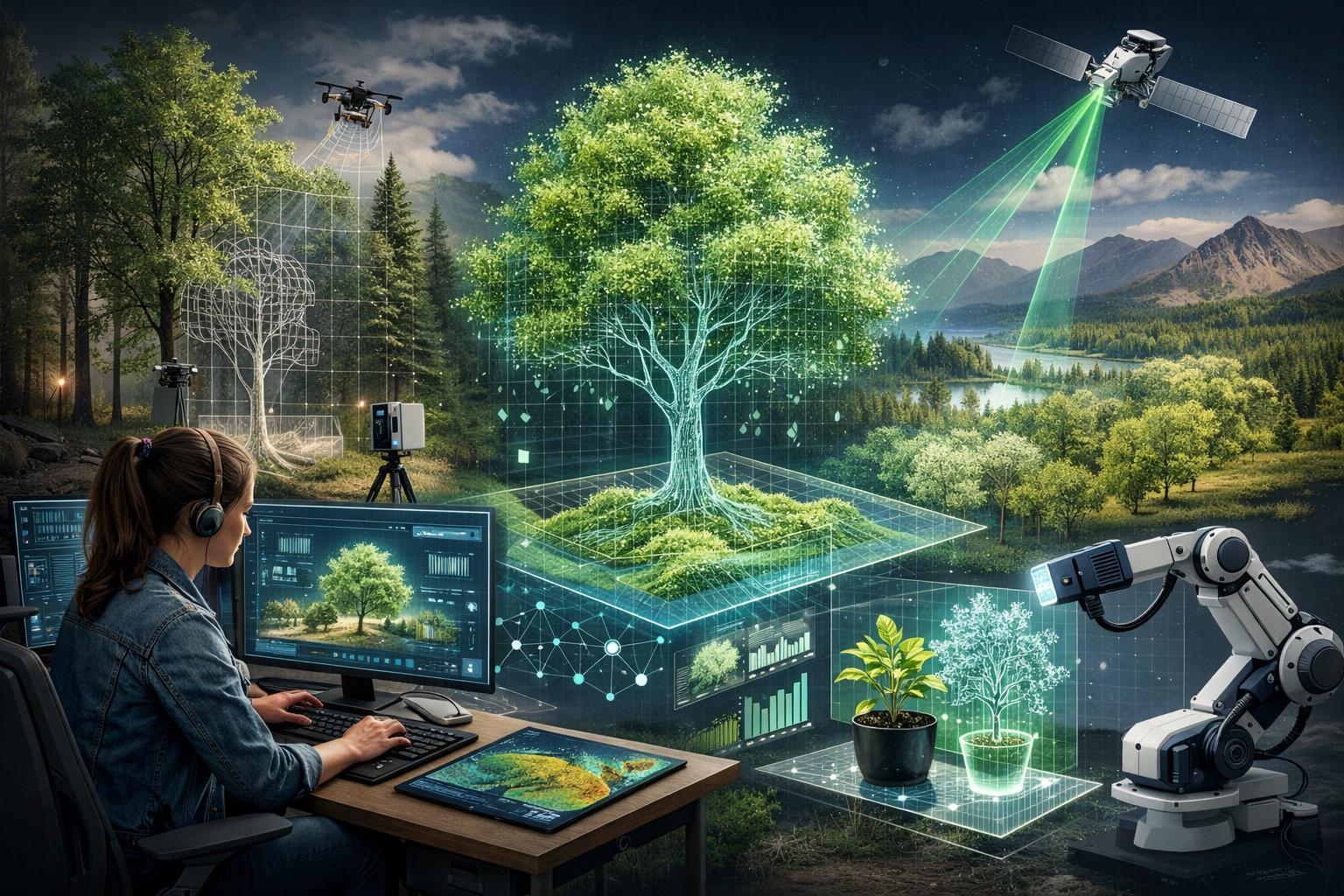
Abstract: Agricultural plants are among the most important and complex living structures shaping human life. They are fundamental to food production, ecosystem balance, and climate regulation, and they play a critical role in human health and economic stability. For decades, computer science has sought to capture and understand the structure and growth of plants, aiming to create digital twins of vegetation. These digital representations can respond to environmental conditions, support simulation and analysis, and enable the exploration of “what-if” scenarios related to growth, yield, and management practices.
This presentation will showcase several recent advances enabled by deep neural representations of mathematical models of vegetation. It will demonstrate how plant representations can be learned directly from data, including vegetation capture using LiDAR or single images. The talk will discuss how latent representations can guide plant development, and how novel deep representations can encapsulate environmental and growth parameters by learning them from simulated data. In addition, several recent methods that combine physics-based models with learning to capture plant growth dynamics and plant–environment interactions will be presented, along with large-scale forest geometry reconstruction from point clouds.